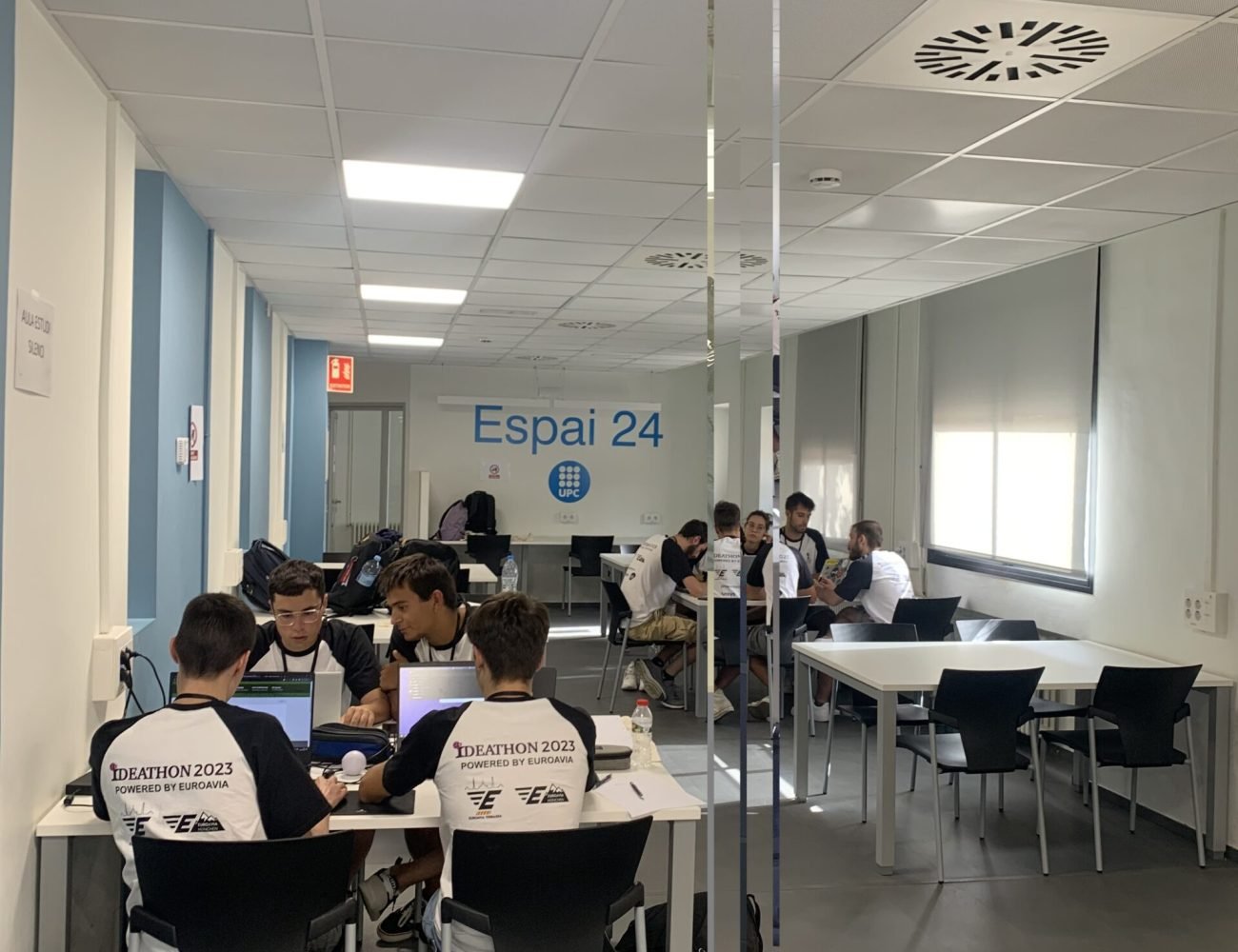
The previous edition of the Ideathon was held last year and consisted of two phases, with the first phase taking place in Terrassa, Spain, and the second in Munich, Germany.
During the first round, five teams looked for solutions to the challenges proposed by our sponsoring companies, Ansys and GTD.
Two of those teams advanced to the final round and traveled to Munich to compete again.
The team that won the first edition was UniBoss from Forlì-Bologna, excelling with their quick problem-solving and creative ideas, even surpassing the expectation of Ansys who sponsored the challenge.


Our AS is located in the heart of Terrassa, one of the biggest cities in Catalonia and 20 minutes away from Barcelona. We make our members fall in love with the aerospace world with many events and activities.

The increasing number of space missions has fuelled the deployment of new launch services that focus on reusability as capability to enable their business models in a competitive scenario, by reducing their operations’ cost, making more agile campaigns and increasing launch rate. Two axes drive that target, first the correct awareness in real-time of the launcher systems’ status. Secondly the flight data exploitation towards predictive maintenance on ground of the reusable systems to ready its availability for next flight. That strategy highly contributes to the reusability and hence to cost reductions and agile campaigns. Your team will be entrusted with the detailed definition of the strategy/methodology for the implementation of an on-board system monitoring (which are the parameters to monitor?) and post-flight RAMS assessment, with the objective of increasing the reusable system availability. The use data exploitation techniques in the domain of predictive maintenance is encouraged (IVHM, integrated vehicle health monitoring, degradation models, supervised models, regression algorithms…), applied to the collected in-flight data (maybe simulated). With these studies we might answer the question, what is the real impact of reusability on launch operations’ costs and launch service business model?
May the force be with you!